

Documentation

Docs

Introduction

What is rune

Philosophy

Why rune

Architecture

Getting Started

Installation

Quick start

Project structure

The dev loop

Tutorial: build an app

1. Create the app

2. Pages & routes

3. Layouts

4. State with Mimir

5. SSR & data

6. API routes

7. Styling

8. Build & deploy

Core Concepts

The application object

Rendering pipeline

Hydration

The build manifest

Configuration (ekko.json)

Permissions

Conventions

Routing

File-based routing

Dynamic routes

The router (useRouter)

Navigation & Link

Guards & redirects

Programmatic routes

Server-Side Rendering

Overview

The ssr() function

Strategies (eager/lazy)

SSR → hydration

Caching & invalidation

SEO

Mimir, state management

Overview

Atoms

Reading & writing

Selectors (derived state)

Subscriptions & the store

SSR & hydration

Persistence & sessions

Patterns & recipes

Pitfalls

Pages & Layouts

Pages

Layouts

Error & not-found

API Routes

Defining routes

Request & response

Middleware

helmet

cors

rateLimit

bodyLimit

validateContentType

csrf

requestId

timeout

errorHandler

httpsRedirect

secureCookies

ipFilter

safePath

Validation & options

Styling & Theming

SCSS

Theming (light/dark)

Asgard integration

No flash (no-FOUC)

Building & Deploying

The build

Static assets

Production deploy

API Reference

ekko:rune

ekko:rune/router

ekko:rune/mimir

ekko:rune/seo

ekko:ssr / css

ekko.json schema

CLI commands

Guides

Rune app from scratch

Recipes

Dark mode

Forms

Data fetching

Authentication

Pagination

FAQ (use cases)

Documentation

Docs

Introduction

What is rune

Philosophy

Why rune

Architecture

Getting Started

Installation

Quick start

Project structure

The dev loop

Tutorial: build an app

1. Create the app

2. Pages & routes

3. Layouts

4. State with Mimir

5. SSR & data

6. API routes

7. Styling

8. Build & deploy

Core Concepts

The application object

Rendering pipeline

Hydration

The build manifest

Configuration (ekko.json)

Permissions

Conventions

Routing

File-based routing

Dynamic routes

The router (useRouter)

Navigation & Link

Guards & redirects

Programmatic routes

Server-Side Rendering

Overview

The ssr() function

Strategies (eager/lazy)

SSR → hydration

Caching & invalidation

SEO

Mimir, state management

Overview

Atoms

Reading & writing

Selectors (derived state)

Subscriptions & the store

SSR & hydration

Persistence & sessions

Patterns & recipes

Pitfalls

Pages & Layouts

Pages

Layouts

Error & not-found

API Routes

Defining routes

Request & response

Middleware

helmet

cors

rateLimit

bodyLimit

validateContentType

csrf

requestId

timeout

errorHandler

httpsRedirect

secureCookies

ipFilter

safePath

Validation & options

Styling & Theming

SCSS

Theming (light/dark)

Asgard integration

No flash (no-FOUC)

Building & Deploying

The build

Static assets

Production deploy

API Reference

ekko:rune

ekko:rune/router

ekko:rune/mimir

ekko:rune/seo

ekko:ssr / css

ekko.json schema

CLI commands

Guides

Rune app from scratch

Recipes

Dark mode

Forms

Data fetching

Authentication

Pagination

FAQ (use cases)

requestId()

Give every request a stable id so you can correlate log lines, across the request and across services.
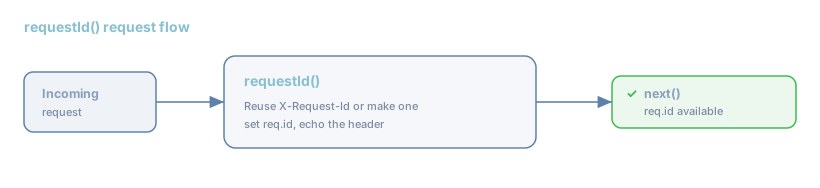
requestId request flow

Use case

When something goes wrong in production, you need to follow a single request through every log line it produced. A request id is that thread: attach it to each log, return it to the client, and a support ticket ("error, id abc123") points straight at the relevant logs.

How it works

It reuses an incoming X-Request-Id header if present (so an id set by your proxy or an upstream service carries through), otherwise it generates a UUID. It sets req.id for your handlers and echoes the id back in the X-Request-Id response header. Then it calls next(). There are no options.

Configuration

No options. Register it first, so every subsequent middleware, handler, and error can include req.id.

Example

1
2
3
4
5
6
7
8
9
import { requestId } from "ekko:web";
 
app.use(requestId());
 
// later, in any handler or middleware:
app.api("GET", "/api/thing", async (req) => {
console.log(req.id, "fetching thing");
return getThing();
});

Notes

Put requestId at (or near) the top of the chain, above errorHandler is fine since the id is set on req immediately, so the error log can reference it. Pass req.id into any downstream service call to extend the trace across process boundaries.

Next: timeout.